Dear Burry’s Church,
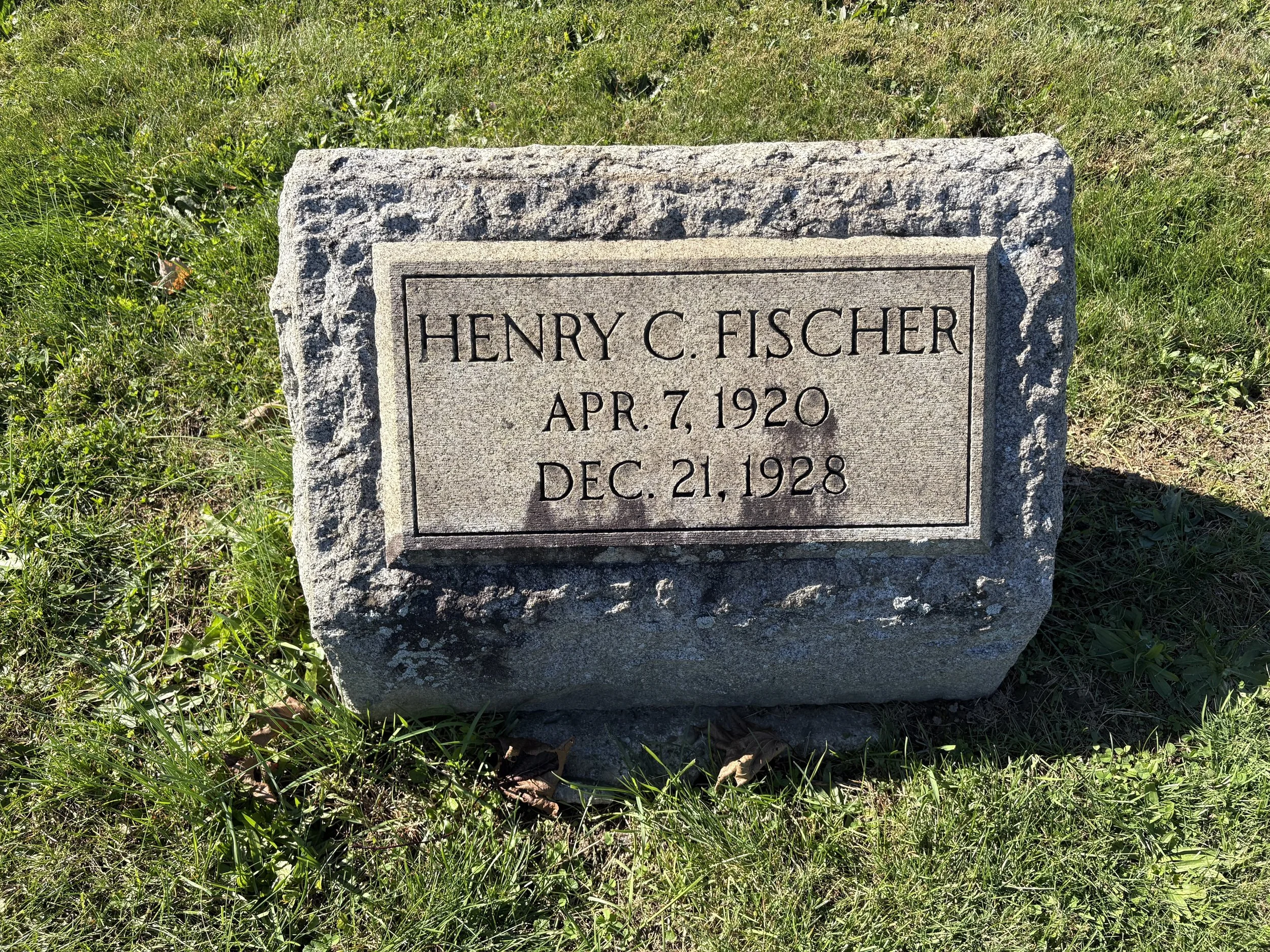
If you stroll through the church’s graveyard, you will find a headstone for Henry C. Fischer (April 7, 1920 - December 21, 1928). It rests about three quarters of the way from the church, sitting closer to the road than the softball field. The stone itself is inconspicuous, lacking any distinguishable decorations or flourishments–only his name and dates etched into it. Next to it sits a larger family stone marking the graves of Henry’s parents, Reverend Theodore and Henrietta Fischer.
Henry Christian Fischer holds two unfortunate distinctions: He was the first to pass away in the former parsonage and his funeral was the first one conducted in the newly erected sanctuary–a project started and completed under his father’s leadership. Burry’s 100th Anniversary Souvenir Book (1935) notes these facts, most likely because his passing was relatively fresh in people’s minds. Yet, what remains uncertain is the cause of death.
The December 22, 1928 edition of The Daily Times (currently The Beaver County Times) features the headline “Minister’s Son Dies of Tetanus.” The article states that Henry sustained an injury to his hand while playing at school, ultimately resulting in an infection. According to the death certificate, Dr. David Fitzsimmons noted “powder burns on hand” as a contributing cause of death. These powder burns most likely occurred when Henry fired a toy cap gun, which often used blank cartridges filled with powder. The burns allowed contaminated dirt to break through his skin, thereby infecting him with tetanus. These injuries and subsequent infections were so common that they earned the nickname “toy-pistol tetanus” (for more information, see https://sangamoncountyhistory.org/toy-pistol-tetanus/).
Knowing what potentially happened leads to the question, why did God allow Henry to die? The answer is not easily discernible, because only God numbers our days. All the stones outside the church remind us that death is inevitable. Walking among those who have gone before us can be a source of anxiety, but for Christians, it should spur us towards hope.
The first question of the Heidelberg Catechism asks, “What is thy only comfort in life and death?” The answer: “That I, with body and soul, both in life and in death, am not my own, but belong to my faithful Savior Jesus Christ, who with His precious blood has fully satisfied for all my sins, and redeemed me from all the power of the devil, and so preserves me, that without the will of my Father in heaven not a hair can fall from my head; yea, that all things must work together for my salvation. Wherefore, by His Holy Spirit, He also assures me of eternal life, and makes me heartily willing and ready henceforth to live unto Him.”
We may not be able to choose when and how we leave this world, but we do bear a responsibility for how we live. Do not live in fear but in the hope secured by Jesus Christ. Live for the glory of God, so on that fateful day, He may say, “Well done, good and faithful servant!”
With much love,
Pastor Christian